At a Glance
| Strategic Outcomes | |
|---|---|
| Start Date | Q1 1st June 2023 |
| End Date | q2 31 May 2026 |
| Funding Source | Earmarked |
| Actual Budget (USD) | 0 |
| Budget Percentage | % |
| Actual Expenditure (USD) | |
| Status | Active |
| GGGI Share (USD) | 420000 |
| Poverty and Gender Policy Markers | poverty, gender |
| Name of Client (Lead/Prime implementer if GGGI is part of a consortium) | |
| Participating Organization (Funding/donor) | Korea International Cooperation Agency (KOICA) |
| Name of consortium members, if any | Good Neighbors International (GNI) and Human Asia |
GGGI Project Code : JO11
Project Manager and Staff +
Project Background
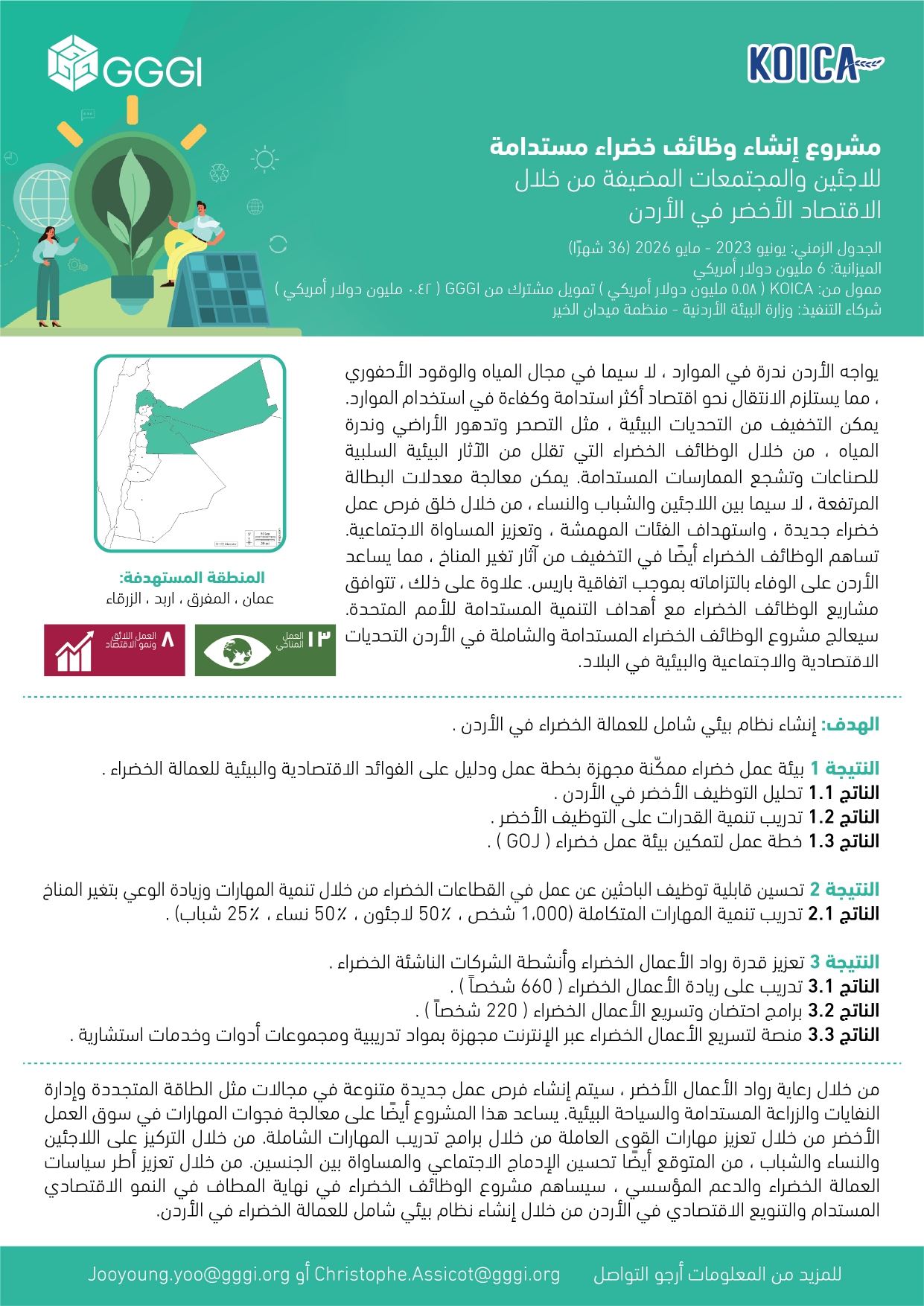
Jordan faces resource scarcity, particularly in water and fossil fuels, necessitating a transition towards a more sustainable and resource-efficient economy. Environmental challenges, such as desertification, land degradation, and water scarcity, can be mitigated through green jobs that minimize the negative environmental impact of industries and encourage sustainable practices. High unemployment rates, especially among refugees, youth, and women, can be addressed by generating new green employment opportunities, targeting marginalized groups, and promoting social equality. Green jobs also contribute to climate change mitigation, helping Jordan meet its commitments under the Paris Agreement. Furthermore, green jobs projects align with the UN SDGs. The sustainable, inclusive green jobs project in Jordan will address the country’s economic, social, and environmental challenges.
Project Outcomes and Outputs
Goal: Establish an inclusive green employment ecosystem in Jordan
Outcome 1 Enabled Green Employment Environment equipped with the action plan
and evidence of the economic and environmental benefits of Green Employment
- Output 1.1 Jordan Green Employment Analysis in Jordan
- Output 1.2 Capacity Development Training on Green Employment (GOJ)
- Output 1.3 Action Plan to enable green employment environment
Outcome 2 Enhanced job seekers’ employability in green sectors through skill development and increased climate change awareness
- Output 2.1 Integrated skill development training (1,000 people, 50% refugees, 50% women, 25% youth)
Outcome 3 Strengthened green entrepreneurs’ capacity and green start-ups’ activities
- Output 3.1 Green Entrepreneurship training (660 people)
- Output 3.2 Green businesses incubation & acceleration programs (220 people)
- Output 3.3 Online green business acceleration platform equipped with training materials, tool-kits, advisory services
Potential Impacts
By fostering green entrepreneurs, diversified new job opportunities in areas like renewable energy, waste management, sustainable agriculture, and eco-tourism will be created. This project also helps address skills gaps in the green labor market by enhancing workforce skills through comprehensive skill training programs. By focusing on refugees, women, and youth, social inclusion and gender equality are also expected to be improved. With strengthened green employment policy frameworks and institutional support, ultimately, the green jobs project will contribute to sustainable economic growth and economic diversification in Jordan by establishing an inclusive green employment ecosystem in Jordan.
Contact
Jordan Country Office
Address: Ministry of Environment, King Faisal Bin Abd Al Aziz St 83, Um Uthaina, Amman, Jordan
For further information and queries, please contact on: infojordan@gggi.org